ai
AI Adoption Needs a Transition Plan
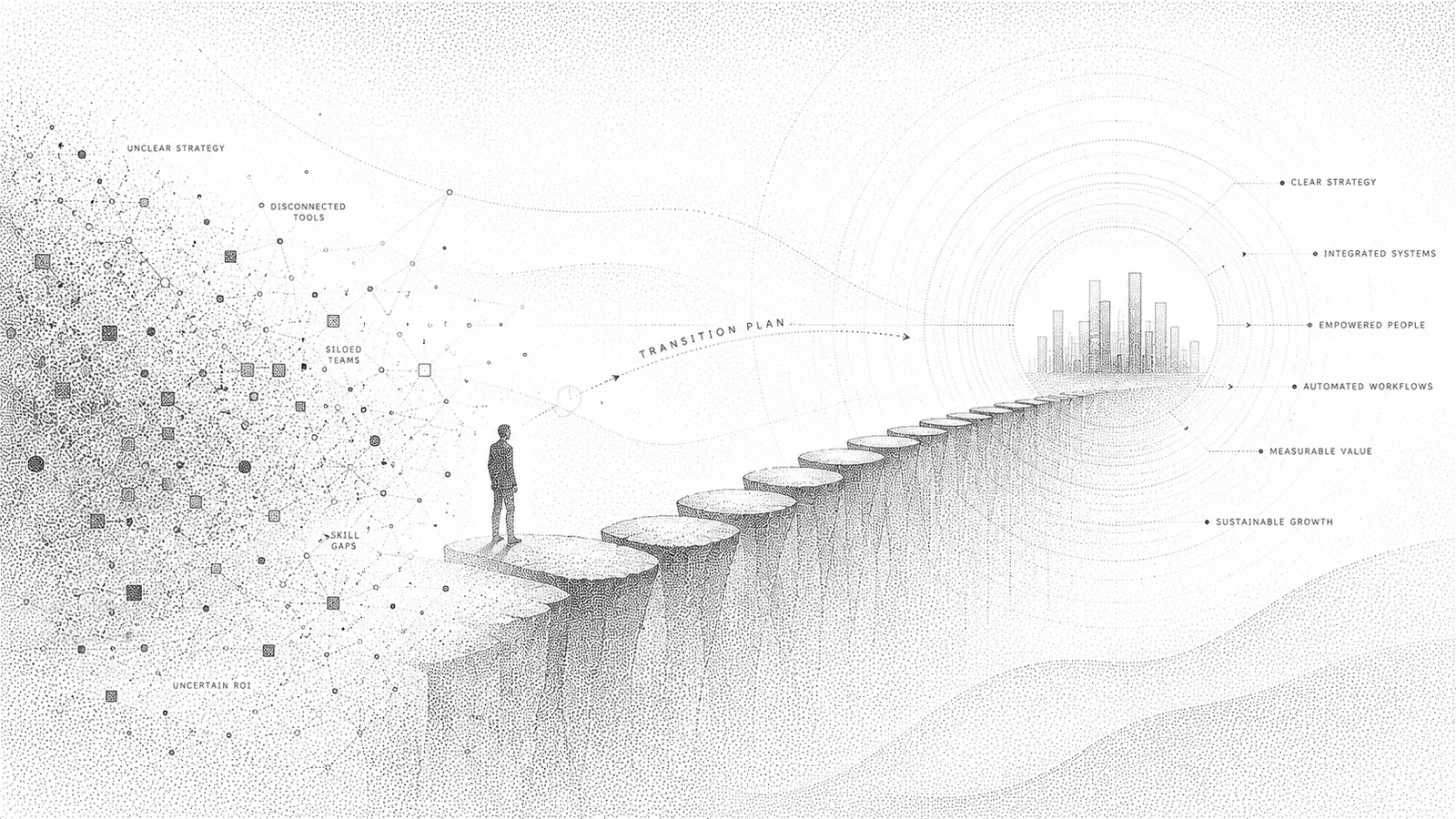
There is no shortage of confident opinion about AI.
I have added some of mine to the pile, although usually with more discomfort than confidence. I keep asking myself who I am to have an opinion about something this large, especially when nobody, including the people building the technology, can say with much certainty where it leads.
But I have started to think that may be the wrong question.
We have plenty of opinions. We have arguments about whether AI is revolutionary or overhyped, whether it will create jobs or destroy them, whether it will free people or diminish them. Some of those arguments are useful. Many are just people standing at different points on the timeline and insisting they are describing the same thing.
What I see far less often are proposals.
What should an organization actually do when AI begins changing the work its people perform? What responsibilities does it have? How should it decide which tasks to automate, what happens to the people doing them, and where the resulting capacity goes?
I have been trying to put one possible answer on paper.
What I wish I had asked earlier
A couple of people whose judgment I trust tremendously recently asked me to join a new nonprofit they are building to help move conversations like this forward. I am not naming the organization yet because it is still taking shape and that announcement should come from its founders.
The invitation made me think about what I could usefully contribute.
After 30 years of building applications, I have to admit something. I have helped introduce technologies whose consequences traveled far beyond the task I was assigned.
Sometimes those consequences were genuinely hard to predict. Sometimes I was too inexperienced to recognize them. Sometimes I was simply excited by what the technology could do and too focused on making it work to think hard enough about what would happen once it did.
The ticket described the task. It did not describe the consequences.
I do not say that as a dramatic confession. I am not claiming that everything I built caused harm, or that technological change should stop until every possible outcome is understood. That would be impossible, and probably its own kind of irresponsibility.
I am saying that I wish I had asked more questions.
- Who benefits from this?
- Whose work changes?
- What disappears along with the inefficiency?
- What happens to the person who used to do the task?
- What new responsibility will replace it?
- What does the organization plan to do with the time and capacity it just created?
I want to approach this transition with those questions already on the table.
The layer that governance standards leave open
There are already serious standards for AI governance, security, risk, and compliance. Those standards matter.
The framework I drafted is not intended to replace or compete with them. It looks at a different layer.
An organization can have well-governed models, strong security controls, careful data practices, and documented compliance while still handling its workforce transition badly.
- It can introduce AI without telling the people affected.
- It can remove the entry-level work through which future experts learn their craft.
- It can describe layoffs as productivity.
- It can free thousands of hours without deciding what those hours should become.
- It can leave people technically employed but with roles hollowed out until their primary responsibility is checking what the machine produced.
That is the gap I am trying to address.
The working title is the Responsible AI Transition Framework. Its purpose is to help organizations evaluate how thoughtfully they are bringing AI into the workforce and identify the next step they can take.
It does not ask whether an AI system is ethical in the abstract. It asks how people are treated as the system changes their work.
Responsible does not mean unchanged
This needs to be said plainly: a responsible transition does not mean preserving every existing task or role.
AI will remove tasks. Some roles will change substantially. New roles will appear, and some existing roles will disappear. Pretending otherwise would make the framework comforting but useless.
The responsibility is not to freeze the organization in place. It is to design what comes next.
When AI absorbs part of someone’s work, the organization should define the new tasks, responsibilities, and development opportunities that will take its place. People need the skills, authority, and support to apply their judgment and experience to more valuable work.
That does not mean everyone becomes a manager of bots. It should not mean spending the day approving machine output or fixing its mistakes.
It can mean solving harder customer problems. Running experiments that were previously too expensive. Finding insights that were buried under reporting work. Improving a service. Building a new product. Strengthening relationships. Teaching others. Taking ownership of a problem that used to sit above someone’s role because the routine work consumed all of their time.
It also does not mean that every person must become the creative director of their department. Some people want clear, defined work that they can do well and leave behind at the end of the day. A humane transition needs worthwhile work for them too.
The point is to give people better options, not impose a new personality on them.
Done well, this is not only good workforce policy. It is good organizational strategy.
A company that uses AI only to reduce labor may become cheaper. A company that reinvests the capacity into better products, service, experimentation, and growth may become better.
Those are very different ambitions.
Six questions for a responsible transition
The framework currently rests on six pillars. Each is phrased as a question an organization should be able to answer through its actions, not just its policies.
1. Transparency
Is the organization honest about where it uses AI and how it affects people?
Workers should know when AI is being introduced into work that affects them. Its role in hiring, evaluation, scheduling, and other decisions about people should be disclosed. Leaders should communicate the real effects honestly, without inflating efficiency claims to justify decisions they already wanted to make.
Transparency does not solve every problem. It makes the other problems possible to address.
2. Transition
When AI changes or removes work, does the organization help affected people move forward?
That includes meaningful notice, funded training, internal mobility, placement support, and financial bridges where necessary.
It also means defining new responsibilities and development paths before the old tasks disappear. Reskilling without a destination is just training theater. People need to know what they are being prepared to do.
3. Augmentation
Is AI being used to expand human capability or simply subtract people?
The same tool can do either.
A responsible organization reinvests freed capacity in quality, service, innovation, mission outcomes, and new work. It redesigns roles so people exercise more judgment, solve harder problems, experiment, build relationships, and take greater responsibility for customer or community outcomes.
It also measures the gains accordingly. Headcount reduction cannot be the only evidence that an AI program worked.
4. Accountability
Is someone responsible for the effect AI has on the workforce?
Good intentions without ownership tend to disappear under pressure.
Organizations need a named person or group responsible for workforce impact, a review before consequential deployments, and a real channel through which affected people can raise concerns and influence decisions.
The people closest to the work often understand its realities better than the people buying the tool. Their participation is not a courtesy. It is useful operating information.
5. Equity
Are the opportunities and burdens shared fairly?
Technological transitions rarely land evenly. The people with the least organizational power are often asked to absorb the greatest risk.
A responsible transition should not concentrate displacement among the lowest-paid or most vulnerable workers while reserving training and opportunity for senior staff. It should also consider whether entry-level work is being removed without another way for people to learn the profession.
If we automate the bottom rung of every ladder, we should not be surprised when we eventually run out of people at the top.
6. Stewardship
Does the organization weigh immediate productivity against long-term wellbeing?
A workforce decision does not stop at the edge of the org chart.
Income lost in one place affects families, communities, suppliers, and demand elsewhere. Rapid change can also damage the organization itself by removing knowledge, trust, and future capability faster than they can be rebuilt.
Stewardship does not require refusing efficiency. It requires recognizing that extracting every available gain immediately may leave the organization and the world around it weaker.
A ladder, not a verdict
I do not want this to become another pass-or-fail badge.
The framework uses a maturity ladder. An organization might be:
- Extractive: AI is adopted for efficiency alone, with little transparency or support.
- Aware: The impact is acknowledged, but the response is inconsistent.
- Committed: Policies, resources, work redesign, and accountability are in place.
- Leading: Human-centered adoption is embedded, measured, and demonstrated in practice.
An organization will probably sit at different levels across the six pillars. That profile is more useful than a single score because it shows where the next improvement can happen.
The goal is not to shame companies for being imperfect. Every organization is learning. The goal is to make the next responsible step visible.
A proposal, offered loosely
This framework is still a working draft.
I expect parts of it to change. Some language is probably too broad. Some measures will be difficult to observe. There may be a pillar missing, or two ideas that belong together, or an assumption that will not survive contact with a real workforce.
That is why I am publishing it now.
I am not trying to sell it. I will make the working document freely available, because this is my attempt to offer a proposal instead of another opinion.
The transition is not complete when an old task disappears. It is complete when people understand what they are newly responsible for, have the support and authority to do it well, and share in the value their expanded capabilities create.
That is the future I would like organizations to design for.
I would genuinely like to know what I have missed.
The working Responsible AI Transition Framework will be posted here soon. If you would like to weigh in on the draft before then, get in touch.