everything-else
What I Love About Calvin and Hobbes

There’s a framed comic strip on the wall of my office. It’s the last Calvin and Hobbes, the one Bill Watterson ran on the last day of 1995, and I’ve looked at it on and off for years while I work. A boy and his tiger on a sled in fresh snow. “It’s a magical world, Hobbes, ol’ buddy,” Calvin says. “Let’s go exploring.” And they push off the edge of the panel and are gone. A houseplant has since wandered halfway across the glass, which somehow feels right.
I found it as a teenager, around seventeen, right when it started running, and it is one of the very few things I loved then that only got better as I got older instead of worse. Most of what grabs you at seventeen you look back on later with a small wince at how simple it turned out to be. This is the opposite. Four decades later, every time I come back to it I find something I was too young to catch the first time. That is the tell that it was never really a kids’ comic. It was a strip about a six-year-old and his tiger that happened to be, quietly, one of the wisest things anyone put in the newspaper.
The imagination
The first thing that got me, and still does, is that Watterson drew the inside of a kid’s head as if it were simply real. When Calvin is bored in class he is not daydreaming about being Spaceman Spiff. He is Spaceman Spiff, crash-landing on an alien planet ruled by his teacher. The cardboard box is not a toy, it is a transmogrifier, a time machine, a duplicator, depending on which side is up. A wagon ride is a philosophy seminar. A snowy yard is a gallery for the most disturbing snowmen ever committed to newsprint.
What I love is that the strip never treats any of this as make-believe to be grown out of. Calvin’s imagination gets the same ink and the same seriousness as the “real” world, because to him there is no difference, and Watterson is plainly on his side. That is a quietly radical position: that the interior life of a small person, the one adults are forever trying to schedule and manage and calm down, is as vivid and as valid as anything happening at the dinner table.
The philosophy
Then there is the fact that a comic strip about a boy and a tiger contains some of the best casual philosophy I have ever read. Calvin and Hobbes spend a lot of time hurtling downhill in a wagon or a toboggan, and while they hurtle they talk about death, meaning, ethics, whether people are basically good, whether any of it matters at all. And then they hit a tree.
That is the whole trick, and it is perfect. The strip is completely sincere about the big questions and completely unwilling to be pompous about them. A kid asks whether there is a point to all of it, a tiger gives an answer that is somehow both profound and useless, and the ground arrives to end the discussion. It taught me, without ever announcing that it was teaching me anything, something I have needed my whole life.
“You can take the big questions seriously and take yourself lightly at the same time.”
Most people manage one or the other. Watterson did both, in four panels, every week.
Keeping the kid alive
Underneath all of it, the strip is making an argument, and the argument is the part I have come to value most as I have gotten older. Do not let the wonder die. Calvin is exhausting, and selfish, and frequently a menace, but he is awake in a way most of the adults around him have forgotten how to be. He notices things. He is astonished by things. He builds entire worlds in an afternoon and is genuinely moved by a fresh snowfall or a good rock.
The strip never once suggests that growing up means putting that away. If anything it warns you against it, gently, by making the adults the ones who have lost the plot. Part of why I have kept coming back for decades is that it works on me like a standing reminder to nurture the kid inside instead of managing him out of existence. The imagination, the wonder, the willingness to be delighted by something small: those are not childish things you are supposed to outgrow. They are the good part, and the world spends an enormous amount of energy trying to talk you out of them.
Laughing at the absurd
And then, thank goodness, it is funny. This is the part I would put above all the rest if I had to choose one. For all its depth, Calvin and Hobbes is one long, warm laugh at how absurd being alive actually is.
Calvin declares war on bath time, on homework, on Susie, on the very concept of Mondays, and he loses, constantly, with total dignity. He forms a club whose main activity is holding meetings about the club. He invents a game, Calvinball, whose one permanent rule is that you may never play it the same way twice. He rages against a universe that is much larger than he is and completely indifferent to his opinions, which is, if you sit with it, the actual human condition rendered as a small boy having a tantrum in the snow.
What the strip models, and what I have tried to steal from it, is the ability to laugh at yourself and at the ridiculous things life throws at you. Not the cynical kind of laugh, which is easy. The other kind, the kind that comes from loving the absurdity instead of resenting it. Life hands you the pointless meeting, the plan that collapses, the snowman that will not stand up, and you can take it as an insult or take it as a joke you are lucky enough to be inside of. Calvin, for all his fury, is fundamentally delighted to be here. That is the trick I keep trying to learn.
Walking away
The last thing I love is not in the strip at all. It is what Watterson did with it. At the absolute peak of its popularity, when he could have licensed Hobbes onto every lunchbox, bedsheet, and car window in the country and printed money for the rest of his life, he refused. No plush toys, no cartoon, no merchandise. He believed the strip only worked because of the ambiguity about whether Hobbes was real, and a stuffed tiger on a store shelf would have answered a question he never wanted answered. So he protected it. And then, on the last day of 1995, after ten years, he ended it while it was still great and walked away.
I find that almost unbearably admirable. We live in a world that will monetize anything you love until there is nothing left of it, and here was a man who looked at a fortune and said no, because saying yes would have cheapened the thing itself. He would rather the work be perfect and finite than enormous and diminished. The older I get, and the more good things I watch get strip-mined for the last available dollar, the less that looks like eccentricity and the more it looks like wisdom.
Let’s go exploring
I glance up at that framed strip more than I probably should. In it, the snow has fallen overnight and erased everything familiar, and Calvin is thrilled. A fresh clean start. Like a big white sheet of paper to draw on. A day full of possibilities. Then the two of them get on the sled, and Calvin says it is a magical world, and off they go.
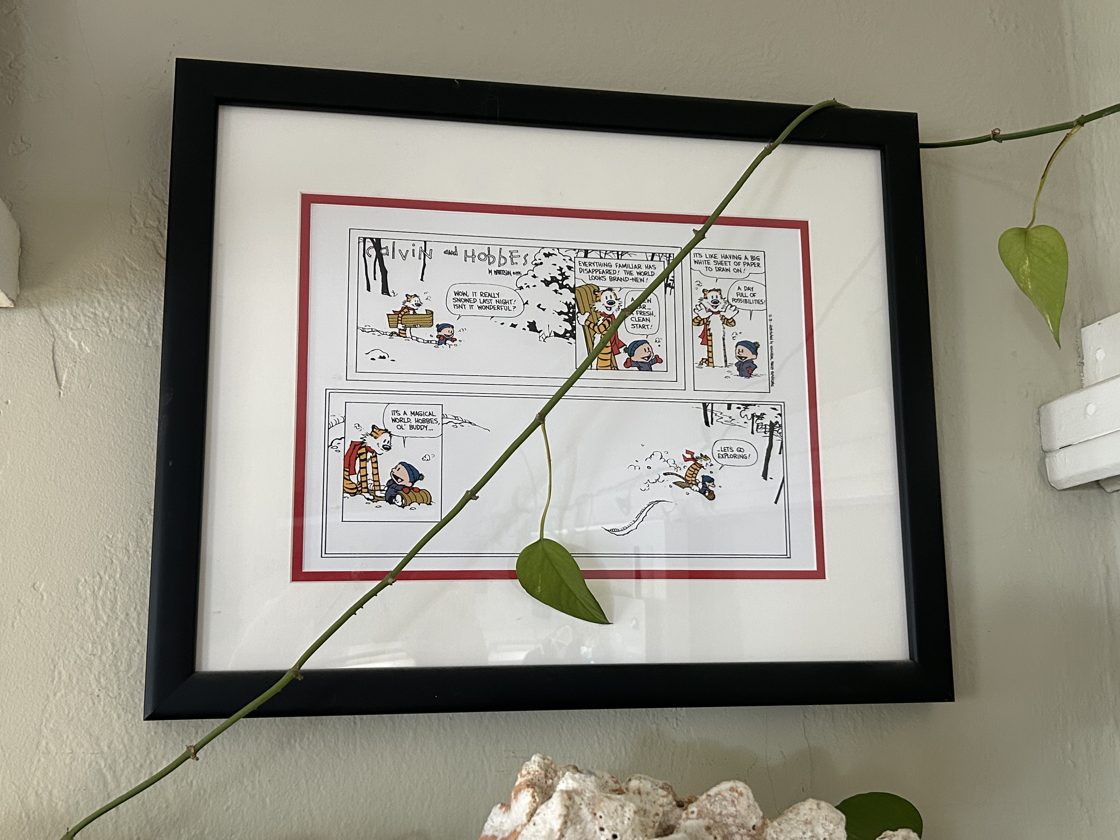
It is not a sad ending. It is an instruction. The world is magical, the snow is clean, the possibilities really are endless, and the only correct response is to go find out what is out there. Thirty years later I still cannot think of better advice, and I got it from a comic strip about a boy and his tiger. Let’s go exploring.