ai
The Apocalypse Has a Permitting Problem
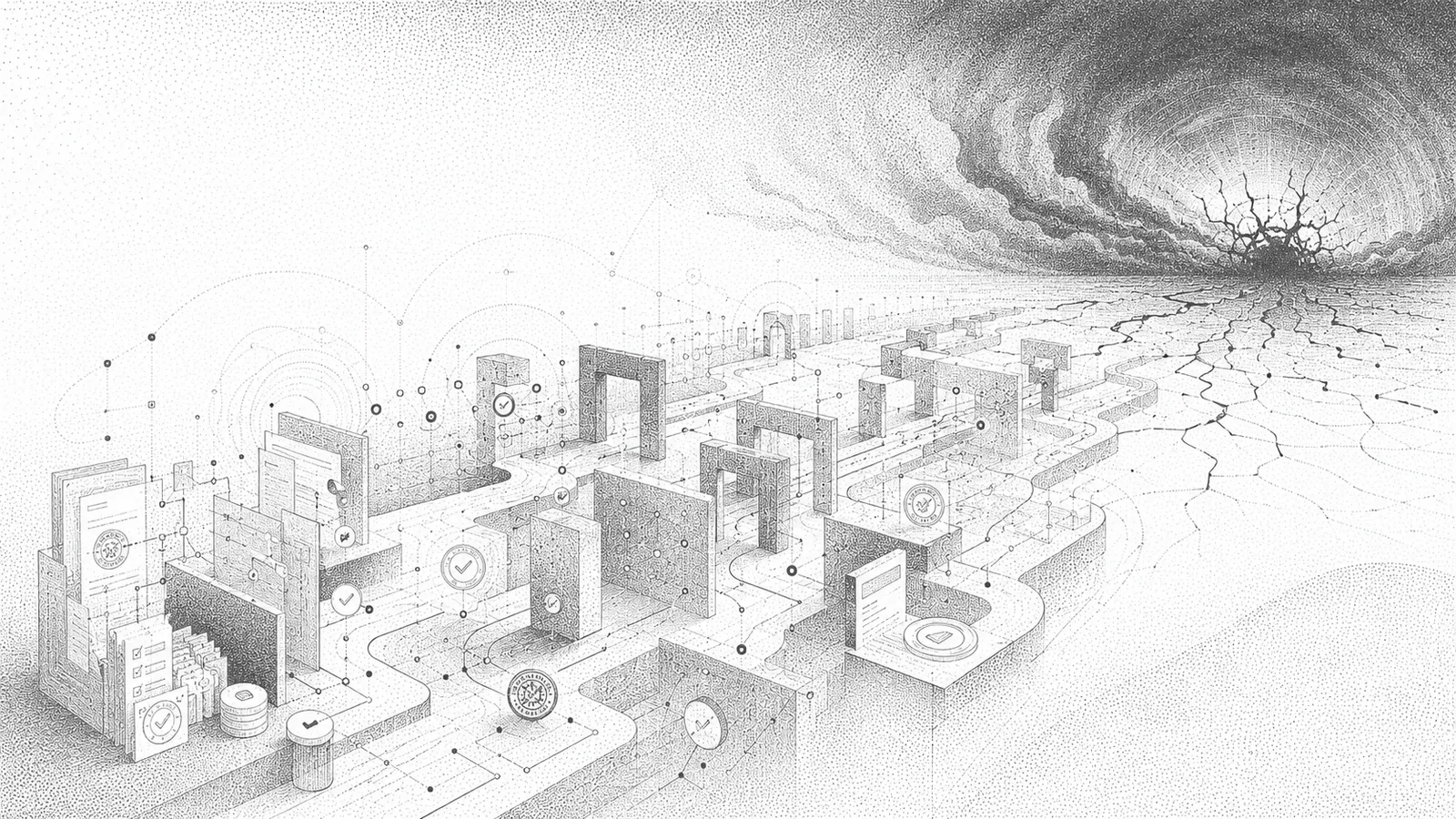
I should confess up front that I have read most of the document I am about to have opinions about, which is not the same thing as all of it. It is called AI 2027, a seventy-page forecast written by serious AI researchers, walking month by month through how we might get from today’s chatbots to machines beyond our control, and in one of its two endings, everybody dies. It made a considerable splash when it came out last year. I covered the remaining pages the way busy people do, which is by watching an interview with the lead author and feeling informed.
This post is about something he didn’t say.
The report card so far
The forecast came out in April 2025, written by a former OpenAI researcher with a strong forecasting record and a small team that includes a top-ranked competitive forecaster. The two endings are a “race,” where things go about as badly as things can go, and a “slowdown,” where an oversight committee pulls the emergency brake at the last responsible moment.
To their enormous credit, the authors filled the thing with concrete, dated, checkable predictions, and then graded their own homework. Their February self-assessment put quantitative progress, in aggregate, at roughly 65 percent of the forecast pace, and a preliminary July update to the same post raised that to about 75 percent. Underneath the aggregate the picture is mixed: revenue ran ahead of the forecast, valuations and the research speedup lagged it, and coding progress depends on which version of their own model you grade against. The qualitative shape of the forecast, the shift to agents, the investment mania, the government scrambling to keep up, has held up better than the individual numbers. As report cards for impossible assignments go, that is a good one.
The prediction hiding in the prediction
Here is the thing that kept nagging at me after the interview ended. The scenario predicts, with striking specificity, that the public will hate all of this. It gives the leading AI company a net approval rating of minus 35. It puts ten thousand protesters in Washington. It has Congress firing off subpoenas and a fifth of Americans calling AI the country’s biggest problem.
And in the slowdown ending, that fury eventually matters. But it matters only after the dangerous system already exists, after a whistleblower has told the world it may be out of control, and after the frontier has passed beyond anything a permit board or a shareholder vote could touch. Until that moment, politics is friction around the capability curve, never a force that bends it.
It predicted the anger would vote. It just assumed the vote would arrive too late.
Finance is feelings
The assumption I find hardest to swallow is the money part. Frontier-lab valuations, and much of the infrastructure boom around them, are priced less on present earnings than on a story about future capability, and when the asset is a story, sentiment is not noise around the fundamentals. Sentiment is a fundamental.
Look at what the sentiment is doing right now. By Data Center Watch’s count, local opposition blocked or delayed seventy-five data center projects worth about $130 billion in the first three months of this year. Only a third of Americans approve of the pace of the buildout, and a majority say they would oppose a data center in their own community. Electricity prices are up more than 30 percent since 2020 for reasons that extend well beyond AI, but data centers have rapidly become the villain in the affordability story, and candidates across the country are going to be asked where they stand. Lawmakers in both parties have already introduced legislation intended to keep ratepayers from funding the grid upgrades required by large data centers, which is the legislative equivalent of a raised eyebrow.
The industry has assembled a political network, including federal and state super PACs, with more than a hundred million dollars in initial commitments to preserve a favorable political environment. That may work in Washington. I am less sure it can win an argument with everyone’s electric bill. I have run marketing campaigns. I would not take that brief.
The nuclear test
Has public backlash ever actually stopped a strategic technology, or does it just make noise while the technology wins anyway. Nuclear power is the closest analogy I can find, and it is instructive.
New reactor construction largely collapsed in America for two generations, through a cascade of local opposition, ratepayer exposure, cost overruns, regulatory conflict, slowing electricity demand, and eventually capital deciding it had better places to be. Nuclear weapons faced protests that were far larger and far angrier, and those protests did shape arms-control politics. But the arsenal was never exposed to the same commercial choke points. It was a state priority, funded outside normal markets and insulated from local permitting.
The difference was never which technology frightened people more. It was who paid, who approved the projects, and where opponents could get leverage. And AI today sits on the nuclear power side of that line. It needs local permits, it leans on ratepayers, and it runs on investors who are free to leave. The whole question is whether the backlash gets its hands on actual policy before the frontier crosses to the protected side, which is exactly the government-contract, national-champion path the scenario describes.
What a political crash does that a financial one doesn’t
Let me concede the strongest counterargument first. A crash does not stop the research so much as sort it. The pure-play labs burn billions a year and live from one raise to the next, so if the funding window slams shut, the rational board decision is harvest mode: monetize what exists, stop training what doesn’t. But the trillion-dollar companies fund frontier work out of diversified businesses that can absorb a severe downturn, and Beijing does not poll Ohio. A purely financial crash mostly concentrates the frontier into the hands least accountable to anyone.
A politically caused crash is a different animal, and the difference shows up in what comes after. The dot-com bust produced little regulation of the internet itself. Investors were poorer, but the public never regarded the underlying technology as a moral offender. The 2008 crash produced Dodd-Frank, because the coalition that was furious at the banks existed before the crash and was still standing there, in office, when the dust settled. A crash caused by voters carries its own governance with it. The people who broke the bubble stick around to write the rules for what gets rebuilt.
That is the mechanism the scenario never models. Not a wise committee choosing restraint at the eleventh hour, but something much more ordinary and much more American: an industry getting repudiated at the ballot box and the ticker at the same time.
The third ending
AI 2027 has a race ending and a slowdown ending, and in both of them the public gets its say only after the dangerous systems exist. The missing one, call it repudiation, happens before, and it takes three ordinary forces arriving together: consumer refusal, investor doubt, and voter anger. None of them requires wisdom or coordination. They require a bad mood, which America can produce on schedule. The scenario models politics as a late reaction to demonstrated danger. It may be underestimating ordinary refusal as an early constraint on the financing and the concrete required to get there.
The customer lever is the quietest and maybe the strongest. Companies cannot sell to people who are unwilling to buy, and they cannot sell to people who are unable to. Every dollar of this buildout is borrowed against a story about future customers, and if the customers decline to show up, whether out of distaste or because the technology hollowed out their paychecks, the story stops cashing. The honest wrinkle is that the scariest systems in the scenario never touch a shelf; they stay inside, racing. But the race runs on money borrowed against those absent customers, and refusal collects the debt early.
I want to be honest about the odds. The authors may simply be right. They are capability people, they model human reluctance as friction on a technology curve, and friction has a lousy track record against curves. One genuine Sputnik moment could flip public sentiment in a quarter, and the sentence “we cannot afford to lose to China” has never once lost an argument in Washington.
But here is what the third ending actually buys, if it arrives: time. Not safety, just time. Time to regulate before the thing being regulated can outrun the regulator. Time to understand what we have built before we build its successor. Time to decide what we want from all this, rather than discovering afterward what it wanted from us. The scenario’s slowdown ending requires a wise committee making the hard call at the last possible moment. I have met committees. I like our odds better with the crankier version: people not buying, investors not believing, and towns not signing the permits.
It would be an ugly way to get lucky. I would take it.